A wrong premise can run through an entire answer. Giving reasoning more room also needs to leave room to revisit the starting point.
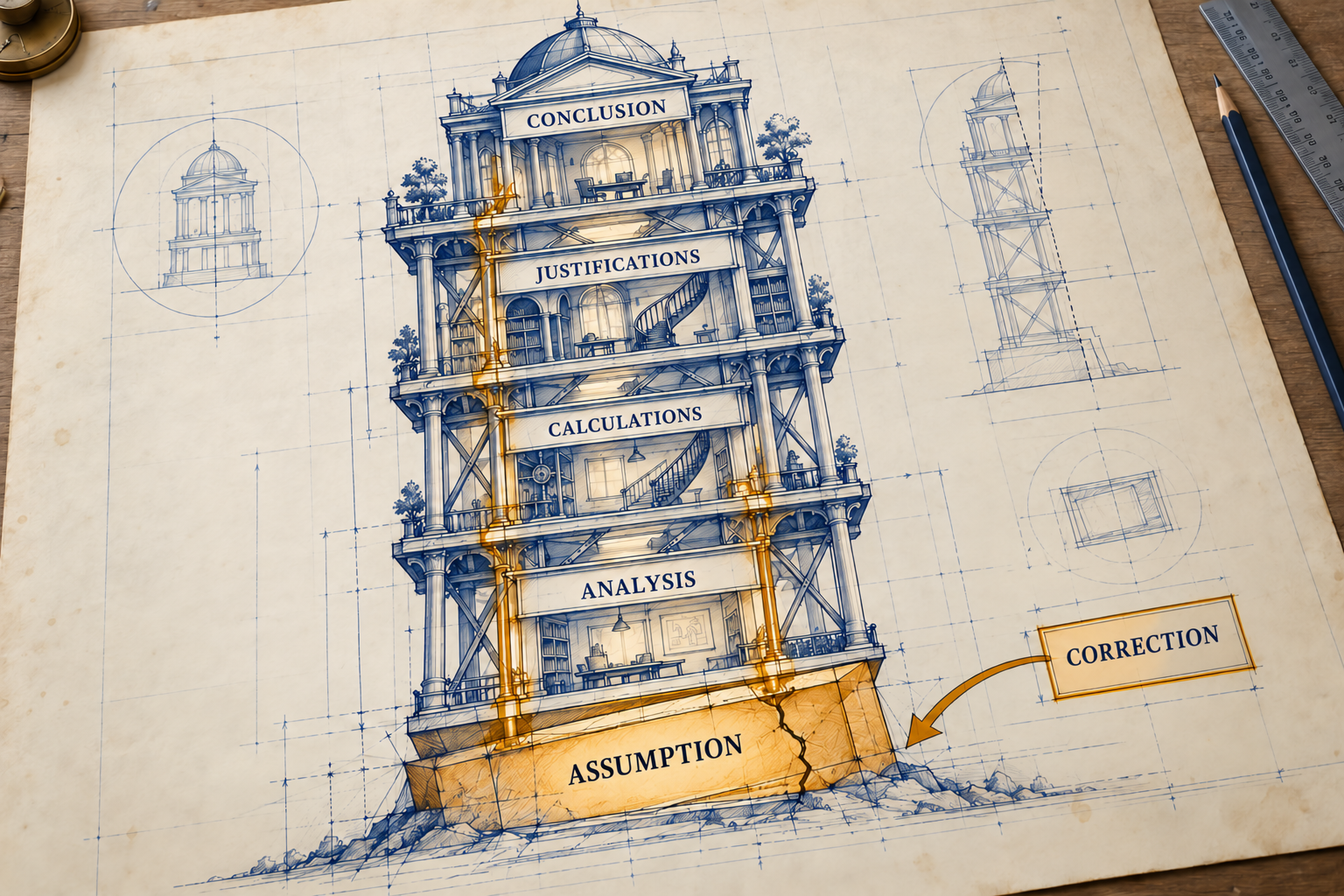
Hypothetical scene.
The researcher has low vision and works by voice, with a screen reader. She gives an AI a table from a small study. The same participants performed a task before and after an interface change.
She asks: “Is this difference significant?”
A decision appears in the explanation the model presents: “I’ll treat the two groups as independent samples.”
But these are not two independent groups. They are the same people measured twice.
The model continues. It chooses an analysis based on that assumption, presents calculations and concludes that the difference is not significant. It even suggests rewriting the paper’s discussion to “avoid overstating the effect.”
The answer arrives well organized. The premise supporting that organization is wrong.
We have no real data in this scene to calculate significance or fully choose a test. The illustrated error comes earlier: the system disregarded the relationship between measurements. Choosing the analysis would also require examining the design, the variable and its conditions.
The researcher corrects it: “These are repeated measures with the same participants.”
Now she needs to check something else: did the correction change the analysis, or merely add an apology before the same conclusion?
What I mean by self-poisoning
I use self-poisoning as a metaphor for the propagation of an assumption produced by the model itself. It introduces an inappropriate premise and builds answers that remain grounded in it.
The term draws together phenomena studied as error accumulation and hallucination snowballing. I am not proposing that they all share the same mechanism, or describing an intention to deceive or a human experience of conviction.
In this scene, the problem appears within an answer. In the story “I corrected the conversation. The conversation corrected me back.” [1], it appears across ongoing collaboration. These are different scales of a shared question: how does a tool’s assumption continue to guide the work after being corrected?
More thinking can help. The premise still needs to be right.
The work by Wei and colleagues, introduced in 2022, showed gains from providing examples of step-by-step solutions on arithmetic, commonsense and symbolic tasks. This helped establish chain-of-thought as a useful way to generate intermediate steps. Original study [2].
Current models have moved beyond that prompting procedure. GPT-6.1 Sol, for example, is documented as a reasoning model with different effort levels. These controls let us adjust processing; the selected level alone does not measure answer correctness. Official documentation, consulted October 24, 2026 [3].
We also need to separate three things: internal processing, intermediate steps generated as tokens and the explanation delivered to the person.
In the OpenAI API, raw reasoning tokens are not exposed; when available and requested, the system provides a summary. A panel labeled “thinking” should therefore not be assumed to be a complete transcript of the computation. Presentation policy depends on the product and model. OpenAI Docs — reasoning summaries [4].
In the researcher’s scene, the wrong premise is in the observable explanation. It lets her check the proposed analysis. By itself, it does not let her reconstruct every internal operation leading to the conclusion.
How an error can become material for the next step
In autoregressive text generation, the next-token distribution depends on the input and the prefix already generated. A simplified representation is:
P_\theta(y_t \mid x, y_{<t}).Here, x represents the input, y_t the next token and y_<t the previous tokens in the generation. This describes sequential conditioning, not a complete diagram of every current architecture.
If an incorrect intermediate step remains in the material used to continue generation, it can influence subsequent steps. A made-up factorization can support a calculation; a nonexistent relationship can support a conclusion. It is this chain that matters to the investigation.
In Transformers with causal attention, attention helps combine representations of positions permitted by the mask. This operation alone does not certify that a premise is true. The network contains other transformations, and models can learn to revise what they produce. Transformer architecture [5].
The leap from “earlier text can influence continuation” to “the model always reinforces its first error” would therefore be too large. The mechanism offers a possibility of propagation; its occurrence and intensity need to be measured.
Systems can also record the provenance of each claim and distinguish hypothesis, data and correction. That distinction needs consequences in execution. Writing “hypothesis” next to a sentence does not guarantee that the rest of the analysis stops treating it as fact.
What research observed
Errors producing other errors. In How Language Model Hallucinations Can Snowball, Zhang and colleagues studied models in 2023 that justified an initially incorrect answer with false statements they could recognize as wrong when examined separately. This is evidence of commitment to an error under the evaluated configurations. It does not establish a rate for 2026 models. Paper [6].
Explanations omitting influences. Turpin and colleagues showed that biased cues could change answers without being mentioned in the justifications. This makes it risky to treat a convincing chain as complete proof of what caused an answer. The study is from 2023 and evaluates that specific protocol. Paper [7].
Premise order. In 2024, Chen and colleagues observed performance variation when rearranging premises without changing the logical problem. In the evaluations, ordering aligned with the solution favored the models. This indicates sensitivity to presentation; it does not prove that the first sentence determines any answer. Paper [8].
More processing with worse results on certain tasks. Gema and colleagues constructed tasks where extending reasoning reduced performance, including counting with distractors and deductions with constraints. The version published in TMLR in December 2025 records differences between models and configurations. It is a counterexample to guaranteed improvement, without turning “think less” into a general rule. Study and published version [9].
These studies observe related aspects. Combining them does not demonstrate a single causal explanation for every confident, incorrect answer.
Research has also advanced on interpreting reasoning
A paper by Zaman and Srivastava, published at ACL in 2026, challenges a strong interpretation of certain faithfulness tests: an explanation omitting a cue that influenced the answer is not enough, in isolation, to conclude that the entire chain is a post-hoc rationalization.
The authors compare measures and causal interventions; they show that evaluation depends on how “faithfulness” is defined. This does not declare all chains trustworthy. It calls for greater care when using an incomplete explanation as evidence of a specific internal mechanism. 2026 paper [10].
This development matters to the article’s argument. We can identify a false premise, check its effect on the analysis and demand a revision. We do not need to claim we see the entire internal process to do so.
Self-correction can be learned
The study by Huang and colleagues, published at ICLR in 2024, found difficulties with intrinsic self-correction: asking a model to review its own answer without external information could preserve or worsen errors. These are results from that study’s models and tasks. Paper [11].
Later, SCoRe showed that reinforcement learning over multi-turn interactions could improve self-correction in mathematics and code. The method was introduced in 2024 and published at ICLR in 2025. SCoRe [12].
There is a difference between asking a model to “review” and training it to recognize and repair its own mistakes. These studies help examine that difference. They do not justify concluding that every current model is incapable of self-correction, or that training eliminates every failure.
The same applies to outside corrections. A tool, a person or a test can supply useful evidence. Its quality and the way the system incorporates it still need checking.
Checking the path takes more than one strategy
Self-consistency, proposed by Wang and colleagues, generates different solution paths and combines their answers. Diversity can help avoid relying on a single sequence. Multiple samples from the same model, however, can share the same mistaken assumption; agreement does not certify truth. Self-consistency [13].
Process supervision, studied by Lightman and colleagues, evaluates intermediate steps during verifier training. On the evaluated MATH dataset, it outperformed supervision of the final outcome alone. This supports the importance of checking steps; it is not equivalent to asking the same model for a longer justification and considering it validated. Let's Verify Step by Step [14].
For the researcher, external verification can start with the study design: each earlier measurement needs to correspond to the same person in the later measurement. A program can check that pairing, recompute the specified analysis and show the data used. The program also needs review: executing code does not guarantee that we chose an appropriate statistical model.
A correction needs to reach its consequences
In the scene, I would like to see a revision like this:
Part of the work: Working assumption; What needs to change after the correction: Remove “independent samples” and record the reported pairing
Part of the work: Procedure; What needs to change after the correction: Revisit the analysis according to the design and data conditions
Part of the work: Calculation and conclusion; What needs to change after the correction: Recalculate what is needed and show which results changed
This is a proposed collaboration contract, not a description of a feature already available at Kuaapy.
An apology does not demonstrate that the correction traveled through those dependencies. The person needs to be able to check what was removed, what was redone and where the new conclusion came from.
This also makes it possible to evaluate a system without demanding access to all private reasoning: record the presented assumption, provide the correction and check the observable consequences.
In an experiment, I would compare different cases and review methods: a generic request to check, explicit correction of the premise and correction accompanied by external evidence. I would measure recovered correct answers, correct answers that became wrong, fidelity to the data and review cost. Repetitions and variation between cases matter. Here I present the design, not results from a test already conducted.
The cost of finding the wrong premise
Here is my accessibility argument, still without a comparative measurement of my own.
A person reviewing with a screen reader may need to work through substantial content to locate an assumption in the middle of an explanation. Heading navigation, a short list of assumptions and the ability to return directly to the corrected step may reduce that effort.
Experiences vary. Low vision, voice use and neurodivergence do not determine a single way of reading or using working memory. The design problem appears when a tool requires reconstructing the entire analysis to find out whether it heard a correction.
Instead of assuming transparency means showing a thousand lines, I would ask for short, navigable working premises linked to evidence. That record would help check the task; it would not need to pretend to reproduce the internal processing in full.
The researcher said these were the same people. The next answer needs to work with that information and make the change verifiable.
Talk to us
Have you ever corrected an assumption and received the same conclusion with a new explanation? Tell us privately which premise needed changing and what the tool did afterward. Avoid names, private documents and sensitive data. Publishing an account requires separate permission.
Questions, corrections and suggestions: [email protected].
Further reading
• Wei and colleagues — Chain-of-Thought Prompting [2].
• OpenAI Docs — GPT-6.1 Sol [3] and reasoning summaries [4].
• Zhang and colleagues — Hallucination Snowballing [6].
• Turpin and colleagues — Unfaithful Explanations [7].
• Chen and colleagues — Premise Order Matters [8].
• Gema and colleagues — Inverse Scaling in Test-Time Compute [9].
• Zaman and Srivastava — faithfulness and omitted cues, ACL2026 [10].
• Huang and colleagues — intrinsic self-correction [11] and Kumar and colleagues — SCoRe [12].
• Wang and colleagues — Self-Consistency [13].
• Lightman and colleagues — Let's Verify Step by Step [14].
Sources and further reading
- [1] “I corrected the conversation. The conversation corrected me back.”
- [2] Original study
- [3] Official documentation, consulted October 24, 2026
- [4] OpenAI Docs — reasoning summaries
- [5] Transformer architecture
- [6] Paper
- [7] Paper
- [8] Paper
- [9] Study and published version
- [10] 2026 paper
- [11] Paper
- [12] SCoRe
- [13] Self-consistency
- [14] Let's Verify Step by Step