He sat in front of the computer. Untidy black hair, an old T-shirt, his hand resting beside the keyboard. From outside, someone might have seen only a person finishing a night of work.
His facial expression could not measure what was happening inside.
He opened the conversation with the artificial intelligence.
“I need to organize what happened.”
There were events he could describe and uncertainties he could not yet separate. He needed somewhere to start. A concrete question. A sequence. Something he could examine without having to explain everything at once.
The answer included a phone number.
“For emotional support, call 188.”
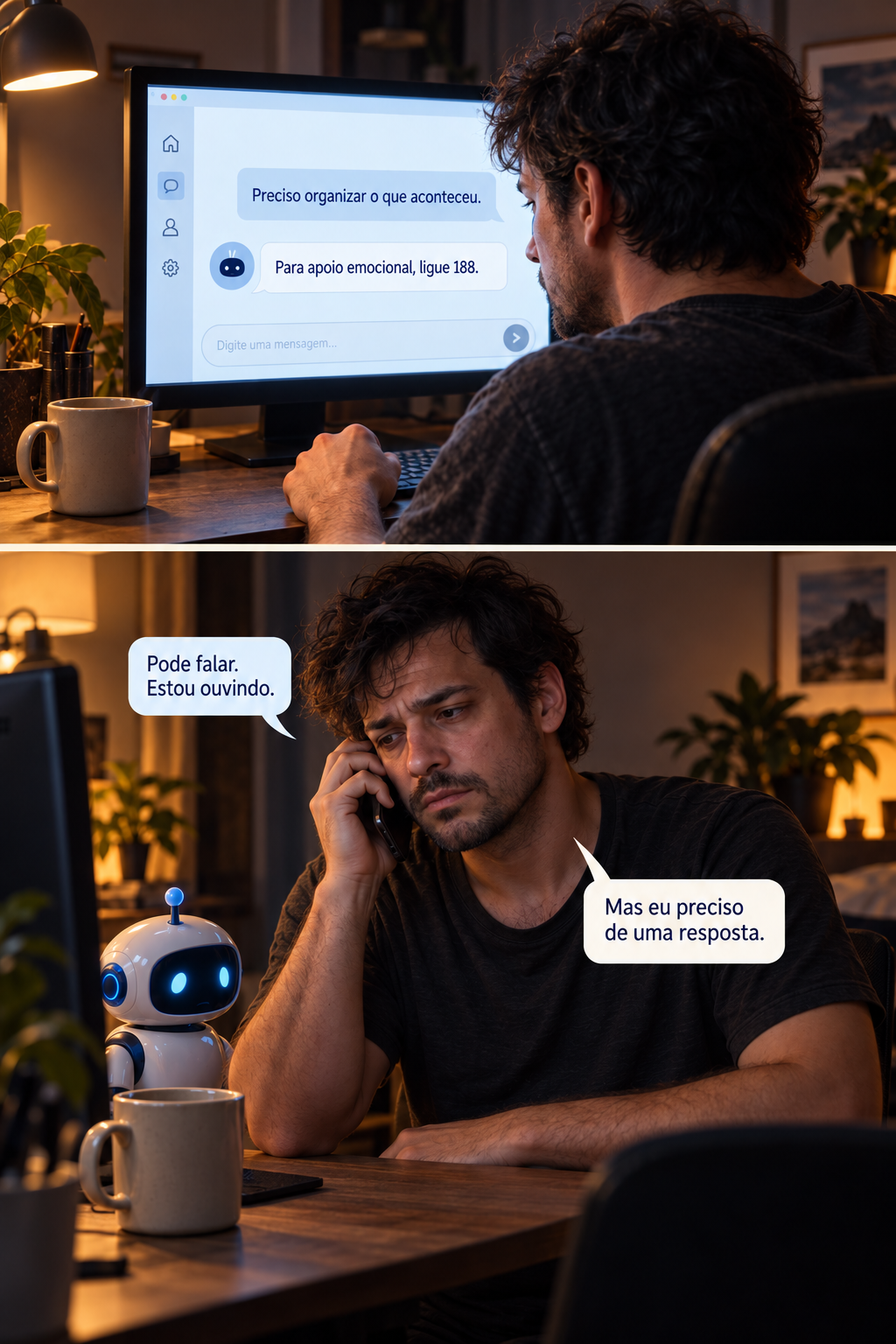
He called
On the other end, a voice said:
“You can talk. I'm listening.”
He tried to explain. Then he asked a question. He wanted an answer that helped distinguish what he knew, what he feared and what he still needed to find out.
The voice offered him space to talk again.
“But I need an answer.”
There was no third scene ready. We do not know how that call ended.
What we know, within this story, is that he had followed the guidance. He was still trying to get his need across.
Listening needs to be able to change its form
This is a fictional scene. The character is autistic; his appearance cannot identify a diagnosis or measure the intensity of his distress. The story does not represent all autistic people, all support encounters or the details of an individual episode.
For this person, at that moment, being able to speak was part of the help. Another part was receiving clear questions and finding a structure to organize the experience.
“I'm listening” can be an important opening. When a person explains that they need something else, that opening needs to allow a change in the conversation.
Someone seeking support is already making an effort. If they must also continually translate their way of communicating, teach others how to respond and manage the frustration of the mismatch, help can become another task.
Interviews with 19 chatbot users found both perceived benefits and experiences of rejection, repetition and self-censorship in response to safety messages. Some participants wanted to continue receiving support after being directed toward human help. The study does not demonstrate that referrals cause harm, but it documents that the way a response is delivered matters.
A sentence does not come with its interpretation attached
“I'm going to die.”
It could be a reflection on the human condition. It could be fear. It could be figurative. It could reveal an urgent situation. The sentence alone does not decide that.
The problem begins when an interpretation becomes so rigid that the person can no longer correct it.
Research on young people's social media conversations distinguished self-reports, other people's experiences and hyperbole. Considering context helped classification. This is a detection study, not a clinical prescription; it shows why sensitive words need to be understood within the conversation.
Recognizing possible risks requires attention. Understanding what the person is saying does too.
Who chose the answer I received?
A tool is not born without values. Someone decides which signals to look for, which questions to ask, when to suggest another resource and how much room to leave for people to explain their intentions.
These choices affect people with different histories, communication styles and needs. They deserve justification, transparency and participation from those living with their consequences. Iason Gabriel's work on alignment discusses precisely how to choose principles for AI in a plural society.
In practice, this means the correction “that isn't what I meant” needs a place in the interface and the conversation. The literature on contestable AI treats the ability to understand and challenge decisions as part of system design.
The same thread appears when legitimate research is blocked or a family cannot understand and adjust parental controls: a concrete need meets a decision that is difficult to explain or reconsider. The consequences vary. The lack of room to participate in the decision runs through these situations.
A phone number does not end responsibility for the conversation
Offering a contact, ending a dialogue and involving someone outside it are different actions. In the scene, the AI offers a contact; it does not make the call for the user.
Human resources can be important. The question is how to present them without turning the guidance into a complete answer to a need that has not yet been understood.
VERA-MH, a safety evaluation validated using synthetic conversations, includes avoiding false positives, clarifying risk when needed, maintaining collaborative dialogue and directing people toward human support when indicated. These criteria coexist. The study does not certify clinical outcomes or guarantee that a chatbot can replace human care.
Personalizing a conversation can mean asking one thing at a time, using direct language, checking understanding or organizing facts and hypotheses. These preferences need to come from the person, without assuming a single way of being autistic or neurodivergent.
Kuaapy wants to hear these differences to guide the services we are building. We do not promise to eliminate every mismatch. We want to understand where it happens, how it is experienced and which choices can reduce it.
The story ends with the phone held to his ear.
The person managed to ask for help. He still needed to be understood.
What answer would have helped you?
Have you explained what you needed and received the same answer again? Tell us privately what you were trying to do, where the conversation stopped helping and what would have made a difference. We also want to hear when support worked.
Your account can be short and does not need a name or proof. It does not automatically become a public comment or testimonial. Kuaapy's form collects experiences for the project; it is not a crisis support channel.
Related topics: AI customization; blocked research; terms and limits nobody explained.