Services · a path taking shape
Useful AI grows from understanding.
From a small research bench to specialised capabilities: we want to make good models more accessible and build services around the needs people bring to us.
Services are in development. The journey shows our direction; it does not set delivery dates or make services available for purchase.
Four connected directions
From a research bench toward useful capabilities.
Each step expands what we can investigate and build. People’s experiences guide the questions; research and resources help us choose the next step.
Three years of research · expansion to be funded
Research bench
Kuaapy is born from three years of research with local resources: open-model inference, security testing, red teaming, and investigation of behaviors, limits, and ways to reduce problems. The next step is to expand testing to larger models and repeat the evaluations on cloud GPUs that could run the service. These measurements will underpin the performance and cost calculations for affordable inference.

Technical direction defined · implementation to fund
Affordable inference service
The second phase is to offer an inference service using open-source models at affordable prices, helping the project begin to sustain itself. The research and technical direction are already defined. Funding will support implementation, integration, testing and the infrastructure needed to put the service into operation. Pricing will account for infrastructure, accounting costs and a margin to sustain and reinvest in the project.

Technical direction defined · implementation to fund
Specialised capabilities
Starting from the open models of the inference service, we will offer versions trained and adapted for different needs. This effort draws on practical experience in training and evaluation: the same base model can give rise to distinct specializations. Funding makes it possible to implement, integrate, and validate these versions in the service. This is not yet our own family of models; it is the evolution of the access offered in the previous stage.

Future offering · supported by research
Specialized Kuaapy models
Offer models from the Kuaapy family, specialized for different needs and developed from the previous stage's research. The proposal is to make them available as open source so that other people can use them too, and to offer affordable hosted inference. Expansion can begin with smaller infrastructure and grow according to available resources. The offering depends on development, evaluation, and operational preparation.
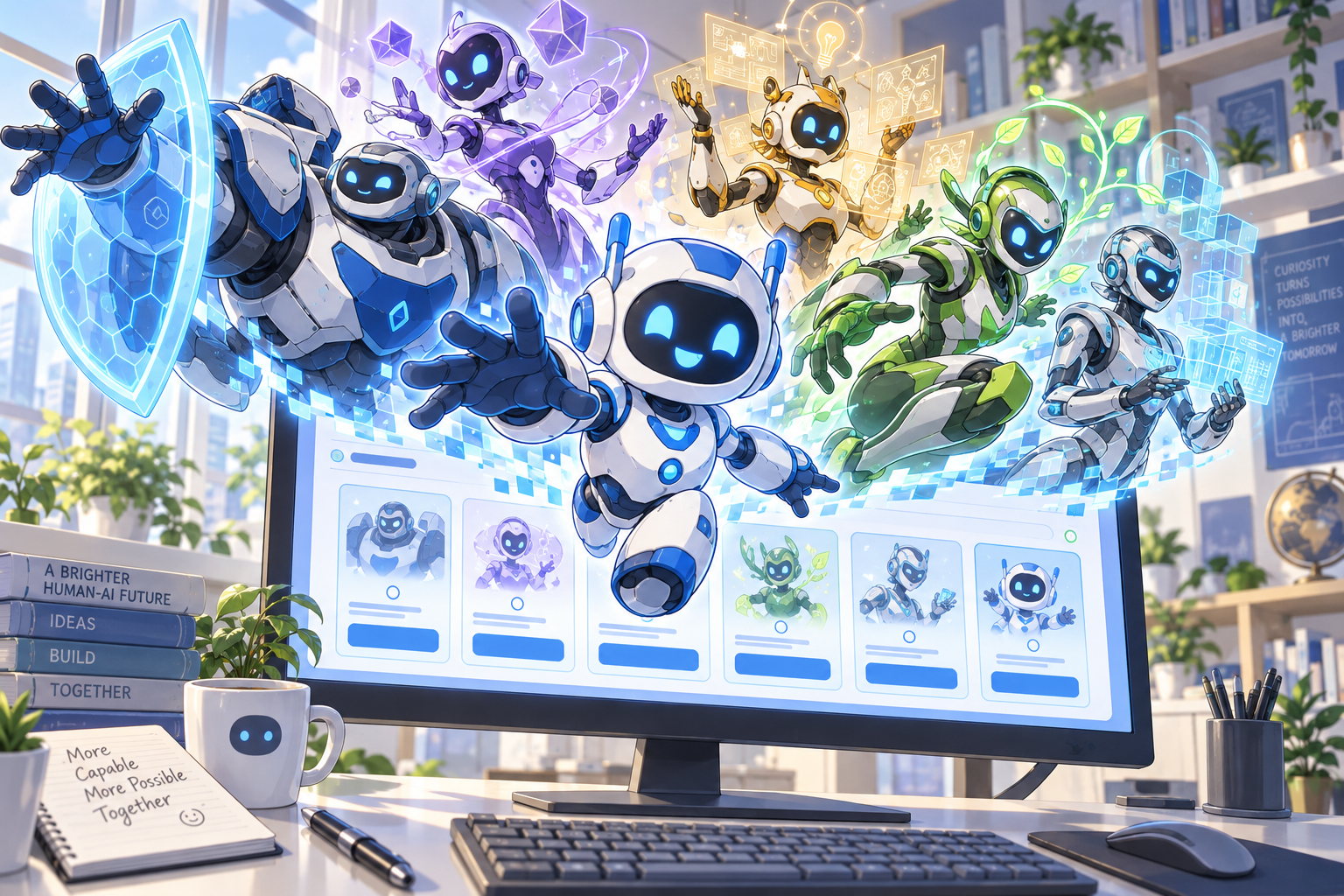
All four scenes are conceptual illustrations. Progress depends on research, feasibility and resources; what people tell us can change the path.
A direction across the journey
Training and adaptation for third-party projects.
We also want to offer specialised training and adaptation for researchers, organisations and teams. A concrete challenge becomes a project with clear objectives, suitable data and its own evaluation — a service direction that can develop alongside this journey.
No training or adaptation service is available at this time.
People · research · services · people
Useful services keep learning from the people who use them.
A post opens a question. Different experiences broaden it. Research can guide what is worth building, and real use brings new questions. Financial support helps provide infrastructure and time for experiments; private stories help us choose where to look.