When accessibility and neurodivergence come up in conversations about language models, the discussion often slips into the language of a ‘niche.’ It sounds like a small group, a secondary demand, something to address later with a help button or a standard response.
The numbers tell a different story.
In October 2026, OpenAI reported that ChatGPT reached 1.2 billion people each week. In August, Google reported that the Gemini app had surpassed 1 billion monthly users. The two metrics are not directly comparable: one measures people per week and the other users per month. Even so, they show the scale at which these products already operate.
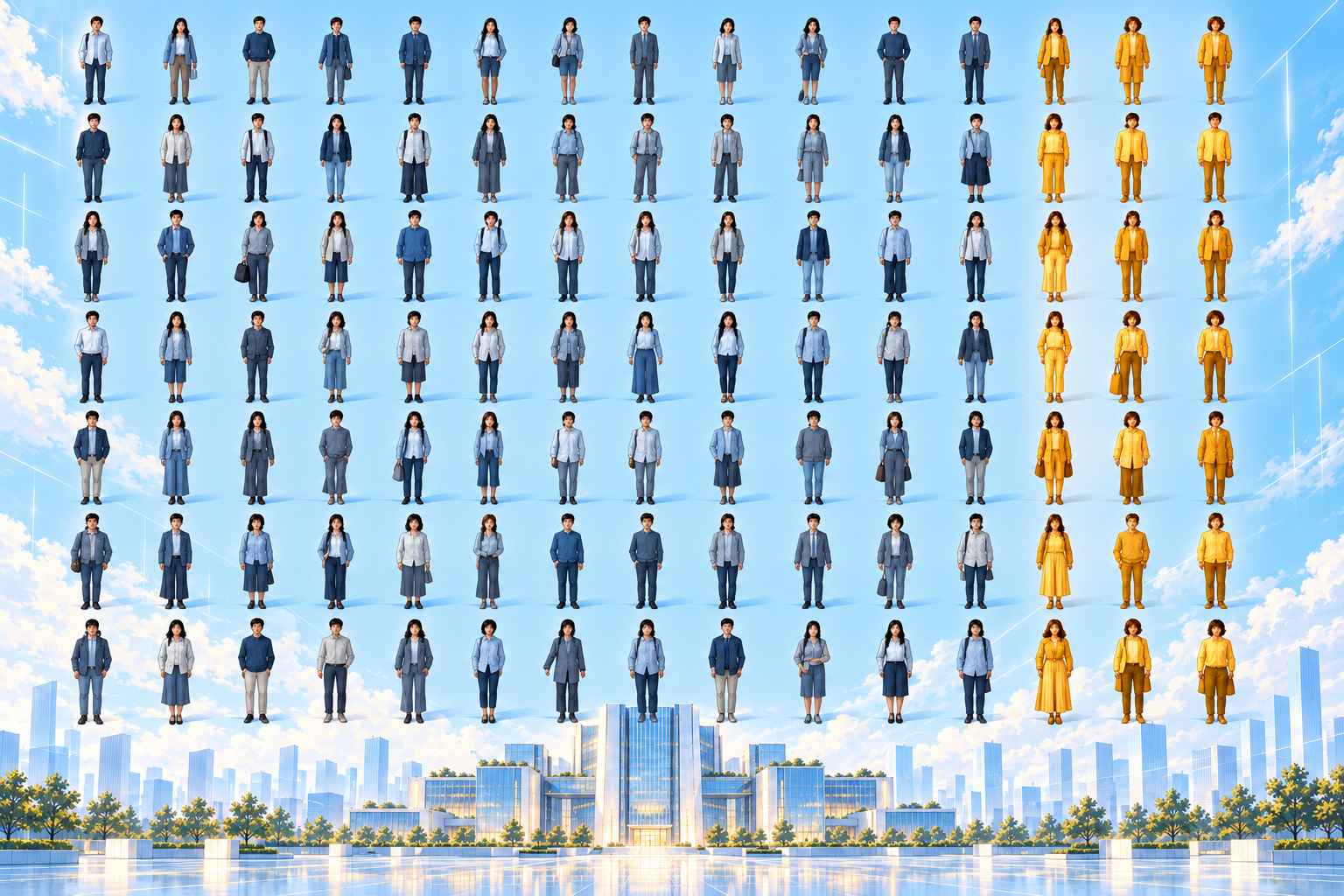
The public that disappears inside the average user
On the other side of the calculation is the population that tends to disappear when an ‘average user’ is imagined. The World Health Organization estimates that 1.3 billion people — 16% of the global population, or one in six — experience significant disability. This is a diverse group whose physical, sensory, intellectual, and psychosocial experiences differ greatly. The number does not describe a single need. It describes the scale of a population that encounters barriers when products and services are built for only one way of perceiving, understanding, and acting.
Neurodivergence presents a similar picture. A review published in the British Medical Bulletin considers it reasonable to estimate that 15% to 20% of the population belongs to a neurominority, accounting for conditions that overlap and often go undiagnosed. Distinct realities exist within that range. The Global Burden of Disease 2021 study estimated that 61.8 million people worldwide were autistic — about one in every 127 people. A global review estimated the prevalence of developmental dyslexia at 7.1% among school-age children. For ADHD, reviews find different results depending on age, diagnostic criteria, and data-collection methods; an international consensus statement cites 5.9% among young people and 2.8% among adults.
These percentages cannot be added together. One person may belong to more than one group, and disability and neurodivergence also intersect. That is why this research does not present 20% or 25% as a single, proven global prevalence. It uses that range only as a scale scenario: close to one fifth of the population and potentially approaching one quarter, depending on the definitions adopted and the barriers considered.
Even the conservative calculation does not fit inside the word niche
If a user base of 1 billion people had a distribution similar to the 15% to 20% estimate used for neurominorities, that would represent 150 to 200 million people. Applied to the 1.2 billion weekly users reported by OpenAI, the same range would represent 180 to 240 million. This does not measure how many neurodivergent people use ChatGPT or Gemini. Neither company has published that demographic composition. It is a simple projection intended to make visible the scale that product design needs to consider.
The point is not that all these people encounter the same barrier. Some rely on screen readers. Others need an interface with fewer stimuli, more literal language, more time to organize a response, or voice transcription that preserves exactly what was said. Some need continuity during a difficult conversation; others are harmed when a system mistakes context for intent and interrupts legitimate work.
When these differences are postponed, exclusion appears in small, repeated places: a button without an accessible name, help text that a screen reader does not announce, an answer that is too long for someone who asked for a short sequence, speech that enters clearly and returns incorrectly transcribed, or a safety warning that ends a conversation precisely when the person needed to keep talking.
The scale is already inside the platform
We do not need to know the exact composition of every platform to recognize the issue of scale. The largest AI tools already serve populations comparable to continents. Within any audience of that size, tens or hundreds of millions of people will not match the abstract user for whom the interface was calibrated.
Treating accessibility and neurodivergence as exceptions in this context does not mean overlooking a rare case. It means postponing product decisions that may affect an enormous share of the platform’s own user base.
The remaining question is one of priority. What changes when a company stops designing for an imagined average user and begins by recognizing that different ways of seeing, hearing, understanding, speaking, and reacting are already part of its real audience?
The answer requires research with the people themselves, disaggregated data, and accessibility testing that does not end with technical compliance. The order of magnitude, however, is already in front of these companies. The group treated as a niche may occupy somewhere between one fifth and nearly one quarter of the room.
If an AI tool has treated the way you see, hear, understand, or communicate as an exception, you can share that experience through Kuaapy’s private channel. Your account may be short, incomplete, or different from this research.
Sources and further reading
- OpenAI — 1.2 billion people per week on ChatGPT
- Google — more than 1 billion monthly users of the Gemini app
- World Health Organization — disability and health
- British Medical Bulletin — neurodiversity at work
- Global Burden of Disease 2021 — global epidemiology of autism
- Systematic review — global prevalence of developmental dyslexia
- World Federation of ADHD — international consensus statement