OpenAI built a reasoning effort selector with appealing names — Light, Medium, High, Extra High, sometimes Ultra — but no indication of usage beside it. The interface looks simple. For someone paying for a usage allowance, that simplicity has a cost: you click without being able to predict what the choice will do to your allowance. As a human being, I can see that gap clearly. It looks like a marketing decision; that's our reading, not an intention we can prove by looking at the screen. The model names raise another question: in the credit rate table, GPT-5.6 Terra has a higher output rate than GPT-6.1 Sol, 300 versus 250 credits per million tokens. Why does an earlier-generation Terra cost more on that measure?
Someone opens Codex to get work done. They choose a model, then find that deceptively simple control. They know they're choosing how much reasoning effort to give the task. What they can't choose with the same clarity is how much of their paid allowance that decision might consume.
So they do what anyone does with software: open the documentation.
Links consulted on October 19, 2026:
Sources and further reading
Our research began with two official pages: OpenAI's model catalog and the ChatGPT Work and Codex pricing page. The models are there. So are prices, credit rates, and explanations of usage limits. The pricing page even says that the model, context, reasoning, and tools can affect usage. It also gives multipliers for the Fast and Ultrafast speed modes.

But we looked for a more specific answer to the choice shown in the interface: when someone changes reasoning effort from Light to Medium, High, or Extra High, what happens to the usage included in their subscription? Is there a relationship they can consult before clicking? We did not find a table or quantitative guidance for that choice on those two pages. And the speed multiplier doesn't answer the question: speed and effort are different controls.
The irony is lovely: to use a research tool, you have to research the tool itself. You find the Moon, the Earth, the Sun, and even a blue star.
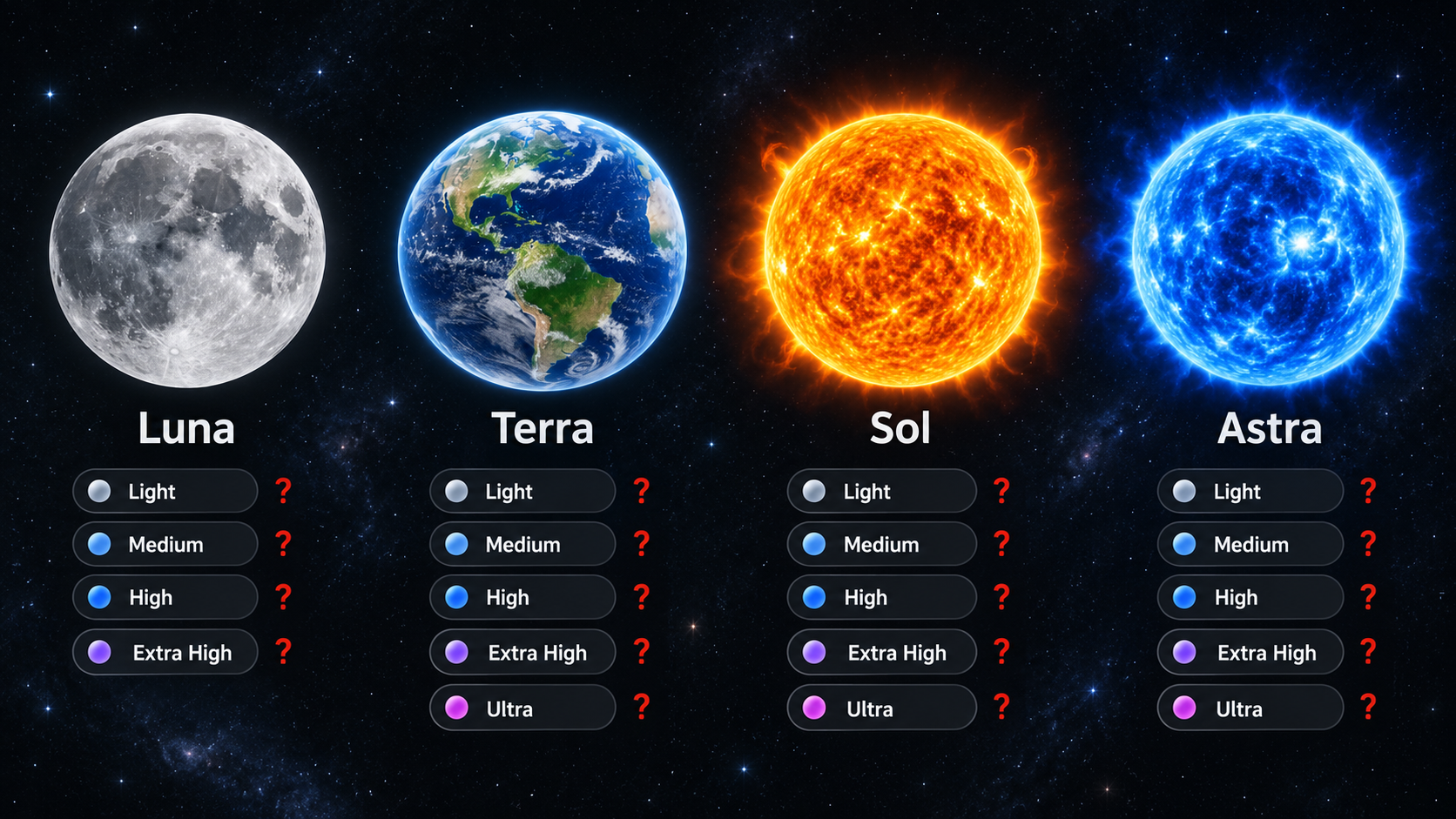
You find numbers for tokens and speed. Yet those red question marks remain: how do you compare the cost of the same task on Light and High within your plan?
There may be an explanation on another page. If so, great: we'd like to read it. Even then, the information belongs alongside the model and price selection, or one clear link away from it. Someone deciding how to use a paid allowance shouldn't have to guess which distant article contains the applicable rule. Software documentation is exactly where people go for an answer like this.
We're not saying that every click on High costs a fixed amount; context, response length, and tools can change a task. Nor are we saying that the absence of a table proves an intention to hide anything. We're making a more concrete point: the information we found doesn't let someone clearly predict how that choice affects their included usage. The gap makes the product easier to present, while leaving the uncertainty with the person paying for it.
Why? Is there a rule we missed, a measurement too variable to present, or an explanation that should sit beside the selector? If someone has a source that answers this, we'd like to include it. Our question remains — and now it's direct: OpenAI, come answer this. Why can people select the effort but not understand, right there, what that choice will do to their allowance?