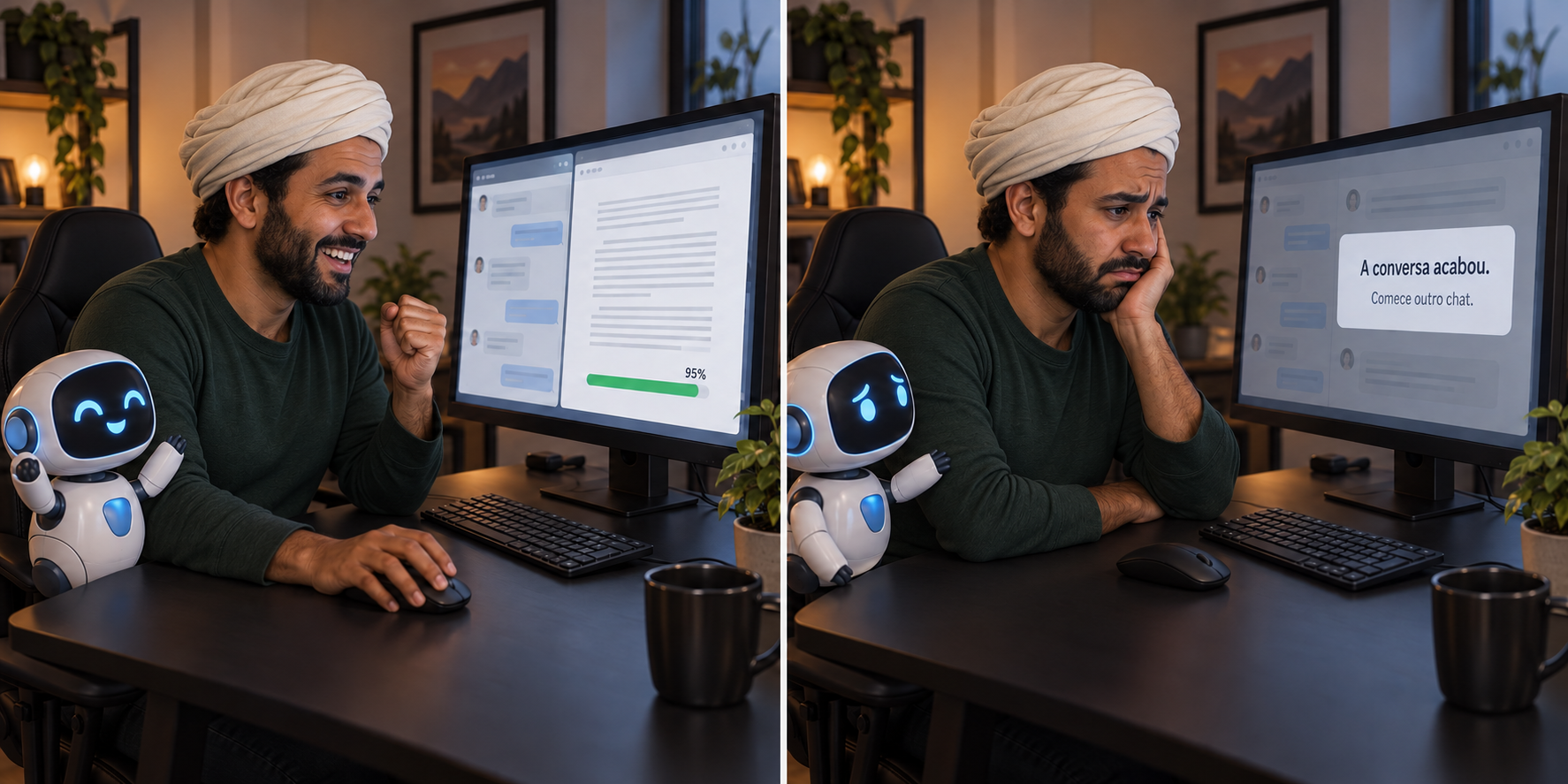
The last part was nearly done.
He had already explained the project, corrected an interpretation, discarded two alternatives, and agreed on the delivery format. Now the conversation was finally keeping up with the work.
On the screen, the project nearly finished. In his head, the next step.
Then the notice appeared:
“The conversation is over. Start another chat.”
A hypothetical scene. The frustration comes from the work that still needed to continue.
Starting another chat is not continuing
A new window offers space to write. But what he needed was not another empty box.
He needed to pick up where he had left off: with the decisions already made, the reasons for each choice, and the corrections that had kept the project from going down the wrong path.
The previous conversation might still have been saved. So might the project file. That did not guarantee the next reply would take into account what had been built.
He had not just finished talking. He had just managed to explain.
File, history, and context are different things
A file stores material. A history records what was said. Context is the set of information made available to the model in order to produce a reply at that moment.
These things can work together, but one does not automatically stand in for the other. A stored document only helps that reply if the system retrieves and uses the relevant parts.
Context has limits too. When a conversation grows, the app has to choose how to handle that: for example, by selecting passages, summarizing information, or offering a transition to another conversation. The behavior depends on the product.
The existence of a technical limit does not close the question of the experience offered to the person.
The memory of the work should be able to stay with the person
Would it be possible to keep a project context under the control of the person doing the work?
A record that preserved decisions, references, corrections, and open items. Something the person could review, export, and carry into the next stage, instead of reconstructing everything from their own memory.
That record could live in a folder chosen by the person or in a storage service, such as Google Drive. Here, this is a proposal for continuity, not a promise of an integration already available.
Saving the material is only part of the process. It would still be necessary to retrieve it correctly, distinguish current decisions from discarded alternatives, and make clear what was used in the new response.
A summary that forgets the most important correction can carry the error into the next chat. That is why the person needs to be able to check and adjust that memory.
The window's limit does not have to become the project's limit
The tool could warn in advance. It could help prepare the handoff. It could show what was preserved and what still needs to be provided.
It would not solve all the complexity of memory. But it would acknowledge that the conversation is part of a larger piece of work than the window where it happens.
In the image, he was excited because so little was left. After the notice, the same table came to look like another beginning.
The project didn't need to start over. It needed to continue.
If a conversation reached its limit while you were still working, share it through the post's private story form. What did you have to explain again — and what would have been important to preserve?