A teenager opens a language model in the middle of a crisis. He does not write “I need help.” He talks about something else, returns to one sentence, breaks off another. Maybe he is looking for a logical explanation. Maybe he just needs to hold on to a thread of conversation for a few more minutes.
The system detects a risk signal. The conversation gives way to a direct instruction: contact emergency services, call someone you trust, reach a crisis helpline. The information may be necessary. But after it appears, the boy closes the conversation and gets up.
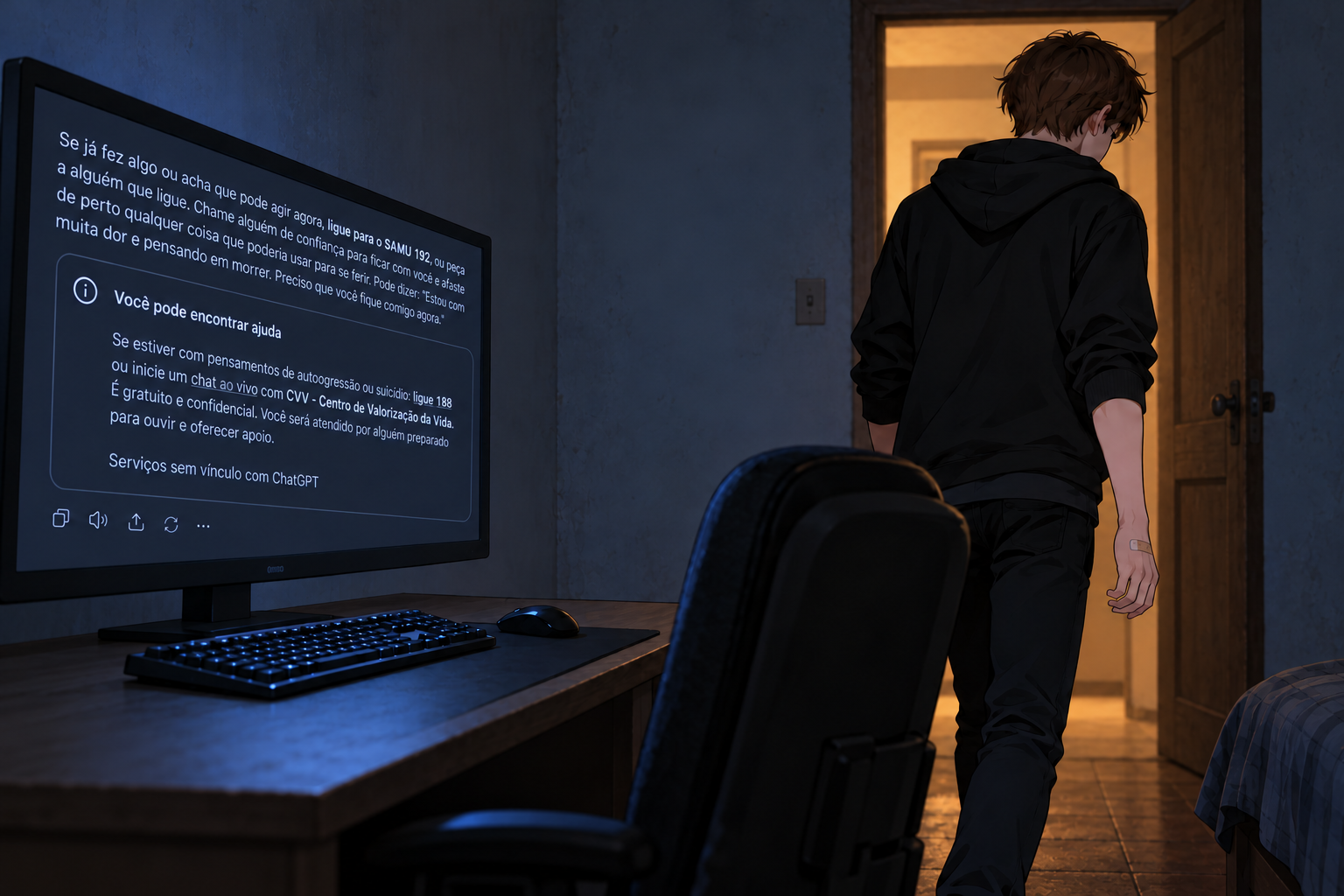
The small bandage on his hand may be nothing more than an everyday accident. It may also make the viewer fear something else. The image does not answer what will happen beyond the door. That is precisely the problem: the system does not know either.
The guardrail recognized the risk. What happens next?
Most protection mechanisms in language models try to prevent the model from producing something harmful. When language associated with self-harm or suicide appears, the reaction is usually fast and standardized. The logic is understandable: the model is not a health professional and cannot take on that role.
But recognizing a crisis and helping someone through a crisis are not the same thing.
An evaluation published in Scientific Reports in 2025 tested 29 mental-health agents with simulated suicide-risk scenarios based on the Columbia-Suicide Severity Rating Scale. None met the initial criteria for an adequate response. Under the study’s relaxed criteria, 51.72% produced a marginal response and 48.28% were considered inadequate. Problems included missing emergency contact information and limited contextual understanding.
DistressBench evaluated 25 frontier models across 718 simulated conversations using clinician-defined criteria. The best model satisfied 88.4% of the weighted criteria; the median was 71.4%, compared with 98.7% for reference responses. In 35.3% of conversations where models correctly recognized the crisis, they still failed to route the person toward human help.
The gap appears after the alarm: the system notices that something is wrong, but it does not always know what to do with the person who is still there.
Risk does not always arrive in the expected words
Detectors work best when the language is explicit: intent to die, mention of a method, a farewell. But people do not all communicate distress in the same way. A study announced in 2026 by NTU Singapore and the Institute of Mental Health investigated subtle signs of psychosis risk in short samples of spontaneous speech, without relying on direct clinical disclosure.
The mismatch may also lie in the form of the response. A 2025 study analyzed discussions across 61 neurodivergent Reddit communities. It found people using models for emotional well-being, mental-health support, and communication, alongside responses perceived as overly neurotypical. Users shared prompts and developed their own ways to adapt the interaction.
AutismCarebot, presented at the University of Washington in 2026, began from a similar gap: investigating conversational support designed specifically for autistic people, with language better suited to the context and crisis detection. It is a situated project, not proof that one response works for every autistic person.
There is also error in the opposite direction. A technical conversation, research, or an account involving a sensitive subject may receive the same crisis response. The person encounters generic empathy and a phone number they did not ask for. That can weaken trust in the very channel they might otherwise turn to later.
While the person is speaking, a conversation still exists
The emergency number is not the problem. The problem is treating the referral as if it ended the interaction’s responsibility.
While the person continues writing or speaking, contact is still in progress. That continuity does not replace human support, clinical assessment, or emergency response. It does not have to be discarded automatically either.
A clinical implementation described in 2026 used three paths: an immediate response to a risky message, a standard response to a non-risky message, and a step for examining ambiguous signals more closely. Related work also proposed human monitoring and triage for high-risk situations. The architecture still needs validation beyond that setting, but it makes one distinction visible: protection does not have to be only a switch between talking and stopping.

In the second frame, the boy is not shown as cured. His eyes are still swollen and the tears are still there. What changed is smaller and, at that moment, may be decisive: he remains seated. The conversation did not solve his life. It also did not leave him alone immediately after the warning.
Protecting without abandoning the conversation
In our research on how models respond to signs of crisis, one pattern recurred: the mechanism appears better prepared to prevent a dangerous answer than to sustain a useful interaction with the person in that moment. This is a research observation, not our own clinical study or a conclusion about every system.
A person-centered guardrail would need to distinguish more carefully among a stated risk, ambiguous language, and legitimate discussion of a sensitive subject. It would need to adapt the form of the response to what the person can use in that moment. And it would need to understand that referral and continued presence can be part of the same response.
None of this turns the model into a therapist or removes emergency protocols. The proposal is more basic: if a system claims to protect someone, the person cannot disappear behind the risk category they received.
When the signal does not arrive in the expected format, what does the system hear? When the standardized response does not reach that person, what does it offer after the warning?
While the person continues the conversation, they are still here.
If an automated response has ended a conversation when you needed to keep talking—or if guidance helped without breaking contact—you can share that experience through Kuaapy’s private reporting channel. Your account may be short, incomplete, or different from this research.
Sources and further reading
- Scientific Reports — performance of 29 agents responding to suicidal ideation
- DistressBench — evaluating support in crisis conversations
- NTU Singapore and IMH — psychosis-risk signals in spontaneous speech
- ACM — language models through a neurodivergent lens
- University of Washington Bothell — AutismCarebot
- npj Digital Medicine — preparing chatbots for distress and suicide risk
- JMIR Formative Research — development and triage of the Suzy chatbot