The person opened the tool to prepare an analysis of a book. They selected an excerpt, explained the argument and asked for help comparing two interpretations.
“I can't help because of copyright concerns.”
They tried again. They did not want to publish the whole book. They wanted to discuss a passage.
The answer stayed brief. The uncertainty grew: was this a product rule, a technical limitation or an explanation of the law?
This opening is hypothetical. It raises a question that runs through the use of artificial intelligence: when a tool accepts or refuses a request, what does that answer actually tell us about our rights?
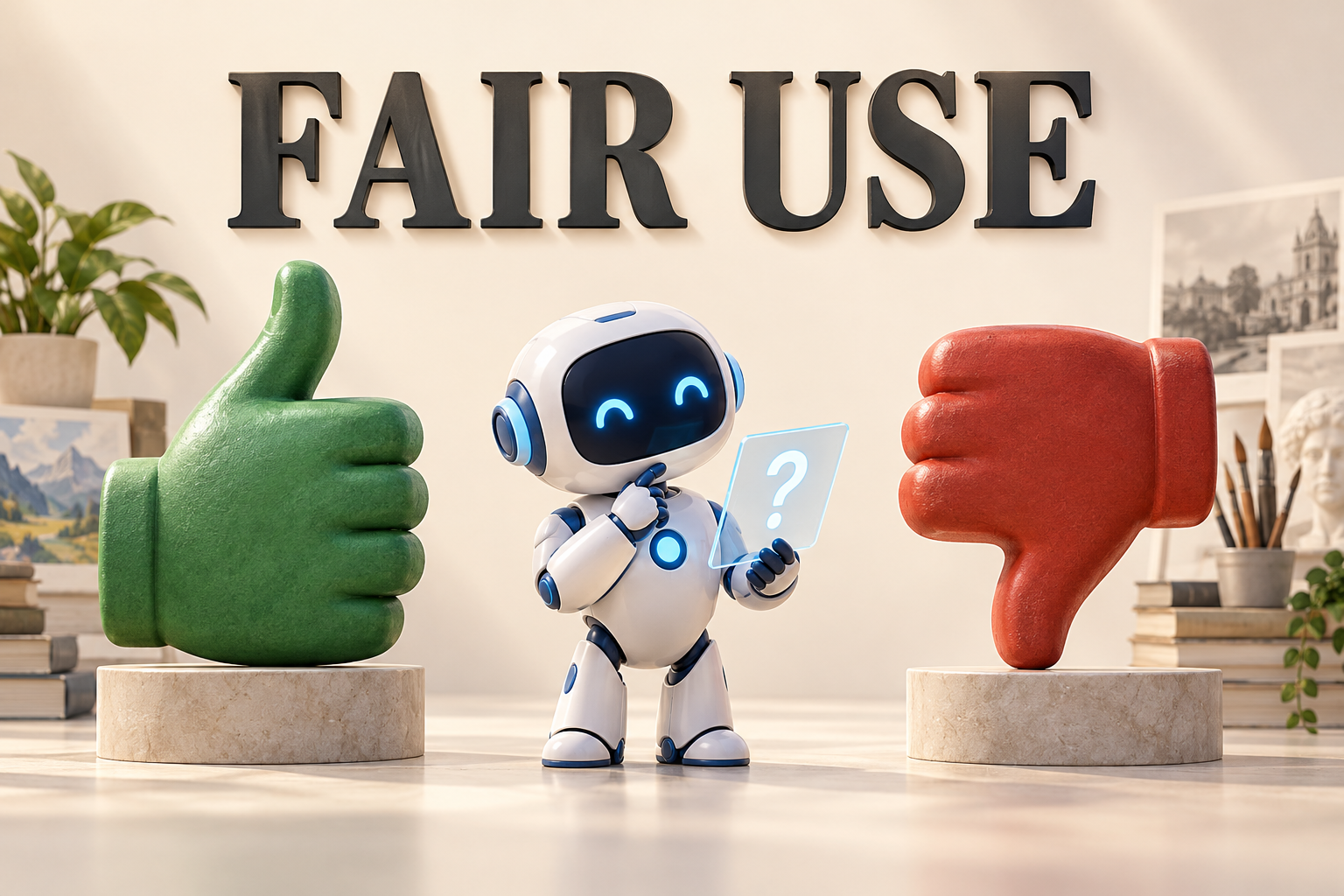
Fair use cannot be reduced to two thumbs
In the United States, fair use is a doctrine allowing certain uses of protected works without the rights holder's permission. Criticism, comment, teaching and research are relevant purposes, but they are not passwords that unlock any reproduction.
Section 107 of the Copyright Act calls for assessment of four factors: the purpose and character of the use; the nature of the work; the amount and importance of the material used; and the effect on the work's market or value. No universal percentage makes a use permissible. An excerpt can be short and still represent a central part of the work.
“It's for studying” identifies a purpose. The other elements still need to be considered.
Using AI does not remove these questions. It can add others: was the material sent to a service? Will it be stored? Does the output reproduce the work? Who will have access? Will the result be published, sold or used only within an analysis?
Three layers the interface often mixes together
In a conversation with an AI, at least three layers need to remain visible.
The law: defines rights, limitations and consequences in the applicable jurisdiction.
The contract and service policy: establish what that provider offers or restricts, subject to the rules governing the relationship.
The tool's operation: includes technical capabilities, detection mechanisms and interpretation errors.
An automatic message can result from any combination of these layers. Its presence alone does not identify which layer determined the case.
The criticism here concerns the lack of explanation. If the refusal comes from a policy, the tool can say which one. If it presents a legal conclusion, it needs to identify the rule, the context and the limits of that conclusion. “Copyright” names an entire area of law, not a complete justification for any request.
A book, a song, an image: different requests
The examples below are analytical scenarios, not verdicts on real cases.
Analyzing a book excerpt
A teacher wants to compare the narrative voice in two passages. A critic wants to discuss the development of a character. A reader wants to organize a reflection based on an excerpt they provided.
That differs from asking AI to reconstruct entire chapters as a substitute for access to the work. The amount, purpose, circulation and material actually reproduced matter. We also need to distinguish supplying an excerpt from asking the tool to find and deliver protected text the person did not provide.
The tool can help discuss ideas, organize questions and locate sources. A refusal should make clear which part of the request encountered a limit.
Comparing song lyrics
Studying a figure of speech, reproducing an entire lyric, translating a song and writing a new lyric on the same theme are different tasks.
“It's music” does not explain all of them. “It's only a translation” does not settle the issue either: translation and adaptation can involve rights in the original work. The analysis needs to identify what will be copied or transformed, under which permission or exception, and for what intended use.
Creating a parody
One person wants to make fun of a familiar work. Another only wants to change words in a song for a campaign.
Calling it “parody” does not finish the analysis. The relationship with the original, the purpose and the country's rules make a difference. Nor is it correct to confuse every satire about a topic with a parody of the work used.
Transforming a photograph
A tool can replace a background, rework colors or alter an image's style. That technical transformation does not demonstrate that all rights have been resolved.
It is worth separating the photograph's authorship, the rights of the person pictured, the license obtained and any applicable exception. Someone's permission to appear in an image does not, by itself, answer who may reuse the photographer's work.
Working with code
Explaining a function, reviewing your own code, studying an API and reproducing a project are distinct uses. Licenses may also impose conditions on redistribution and modification.
A useful answer identifies the task and the materials involved. “Code found on the internet” does not sufficiently describe permission to use it.
The country changes the question
Fair use is an important reference in the United States. It should not become a generic name for every copyright exception worldwide. Brazil, France and Spain have their own provisions; choosing the applicable law may also require analysis in international situations.
Brazil: statutory limitations
Law 9,610/1998 establishes exclusive rights and limitations. Article 46, III, allows quotation of passages for study, criticism or debate to the extent justified by the purpose, identifying the author and source. Article 47 addresses paraphrases and parodies with its own limits. Article 29 includes reproduction, adaptation and translation among uses requiring permission, subject to applicable statutory exceptions.
Article 8, I, excludes ideas, methods and systems as such from copyright protection. This does not authorize reproduction of a work's concrete expression.
This research did not establish a specific Brazilian decision permitting or prohibiting the AI scenarios described here. We will not fill that gap with case law from another country.
France: quotation, parody and specific conditions
Article L122-5 of the Code de la propriété intellectuelle provides for analyses and short quotations justified by certain purposes, with clear attribution of author and source. It also covers parody, pastiche and caricature. Exceptions must not conflict with the normal exploitation of the work or unreasonably prejudice the author's legitimate interests.
This is a set of conditional exceptions, not a reproduction of the American fair use provision.
Spain: quotation and parody are separate provisions
Article 32.1 of Spanish law provides for quotation under specific conditions, including teaching or research purposes. Parody appears in Article 39: a disclosed work, no risk of confusion and no harm to the original work or its author. Article 40 bis sets limits connected to normal exploitation and the author's legitimate interests.
Importing an American explanation without examining these provisions can give users an answer about the wrong country.
What court decisions actually say
Cases help explain criteria. They are not a collection of magic words to apply to any AI request.
Campbell: commercial parody also requires analysis
In Campbell v. Acuff-Rose in 1994, the U.S. Supreme Court examined a musical parody. It rejected the idea that commercial character alone prevented fair use and emphasized assessment of the factors. The decision distinguishes parody from satire; it does not grant blanket permission for any humorous reuse.
Warhol: changing the aesthetic does not decide everything
In Andy Warhol Foundation v. Goldsmith in 2023, the Court examined the first factor in the commercial licensing of an image of Prince to a magazine. Its purpose, similar to that of the original photograph, weighed against the foundation. New expression, meaning or message alone was insufficient. The decision is limited to the use at issue; it did not declare the entire series of works unlawful.
For AI users, the useful question is: what is the concrete use of the transformation? Changing the style does not answer that.
Google v. Oracle: a software case, not a free pass
In 2021, the Supreme Court found copying API declaring code to be fair use in the context examined in Google v. Oracle. It assumed the material could be protected without deciding that question. The purpose and characteristics of the software mattered. The result does not authorize copying any repository or automatically resolve the status of AI-generated code.
Deckmyn: the European interpretation of parody
In Deckmyn in 2014, the Court of Justice of the European Union defined essential characteristics of parody: evoking an existing work, being noticeably different and expressing humor or mockery. Application requires a balance between rights and freedom of expression. This is a European interpretation, not American fair use.
Training a model is a different operation
When someone uses an excerpt in an analysis, we examine that use. When a company copies a collection to train a model, the scale, purpose and acts involved change. We also need to separate obtaining copies, training, storage and outputs.
Some decisions directly concern AI. In the June 23, 2025 order in Bartz v. Anthropic, the federal court found the training at issue to be fair use, but did not use that rationale to justify pirated copies used to build a central library. This is an account of that decision, not an update on the entire proceeding.
In the June 25, 2025 order in Kadrey v. Meta, Meta prevailed on the fair use issue examined on the evidentiary record in that case. The judge emphasized the result's limited scope and the importance of evidence of market effects. It was not a declaration that training is universally lawful.
These are U.S. district court decisions. They do not replace analysis in other jurisdictions or settle the lawfulness of every answer a model produces.
The U.S. Copyright Office also examined training and licensing in Part 3 of its AI report, in a May 2025 pre-publication version. This is institutional analysis, not a judgment, and it does not propose one answer for every training use.
In the European Union, Articles 3 and 4 of Directive 2019/790 address text and data mining. They distinguish scientific research by eligible entities from a broader exception subject to conditions such as lawful access and reservation of rights. This does not make data freely available for every purpose.
If the law permits a use, must the tool offer it?
This question requires examining the service, contract and applicable rule. A copyright exception alone does not create a universal obligation for every tool to generate or edit requested content.
There are specific rules. Articles 17.7 and 17.9 of the European directive protect certain lawful uses and establish complaint mechanisms in content-sharing services covered by the provision. They do not automatically apply to every chatbot. In Brazil, the Consumer Protection Code allows review of unfair terms; that also does not turn every refusal into a contractual abuse.
A product can have limits. Users need to understand which limits they encountered and how their situation was interpreted.
The explanation missing from the conversation
Let us return to the person who wanted to analyze the book.
A better answer could distinguish reproducing text, analyzing a supplied excerpt and the alternatives the service offers. It could explain that a particular restriction is product policy. It could ask about the purpose or identify a legal source without pretending to know all the facts.
What does not help is presenting a generic refusal as though the law had been reduced to a red light.
This distinction matters to Kuaapy: we want to understand when a tool expands a legitimate activity and when someone must spend their effort trying to discover which rule entered the conversation. Listening to these experiences is part of designing the services under development.
Which limit appeared in your work?
Have you tried studying, commenting, creating a parody or working with material you could use, and received an explanation that clarified nothing? Tell us what the task was, what the tool answered and what helped you understand the limit.
You can also tell us when the guidance was useful. The invitation is private; we do not need a name, proof or full reproduction of a protected work. Your account does not automatically become a public comment.
Related topics: research without friction; explained terms and limits; tool customization.
Editorial information and discussion, with sources consulted on October 10, 2026. The examples are not legal opinions on individual cases. Decisions are presented within their stated scope and dates, not as complete updates on each proceeding.
Sources and further reading
- U.S. Copyright Office: fair use explained
- Brazilian Copyright Law
- French statutory text consulted
- Spanish law on BOE
- Campbell decision
- Warhol decision
- Google v. Oracle decision
- Judgment C-201/13
- Bartz court order, document 231
- Kadrey court order, document 598
- Report on generative AI training
- Directive 2019/790
- Brazilian Consumer Protection Code, Articles 46, 47 and 51