The toaster arrived with a booklet. The artificial intelligence tool arrived with a checkbox.
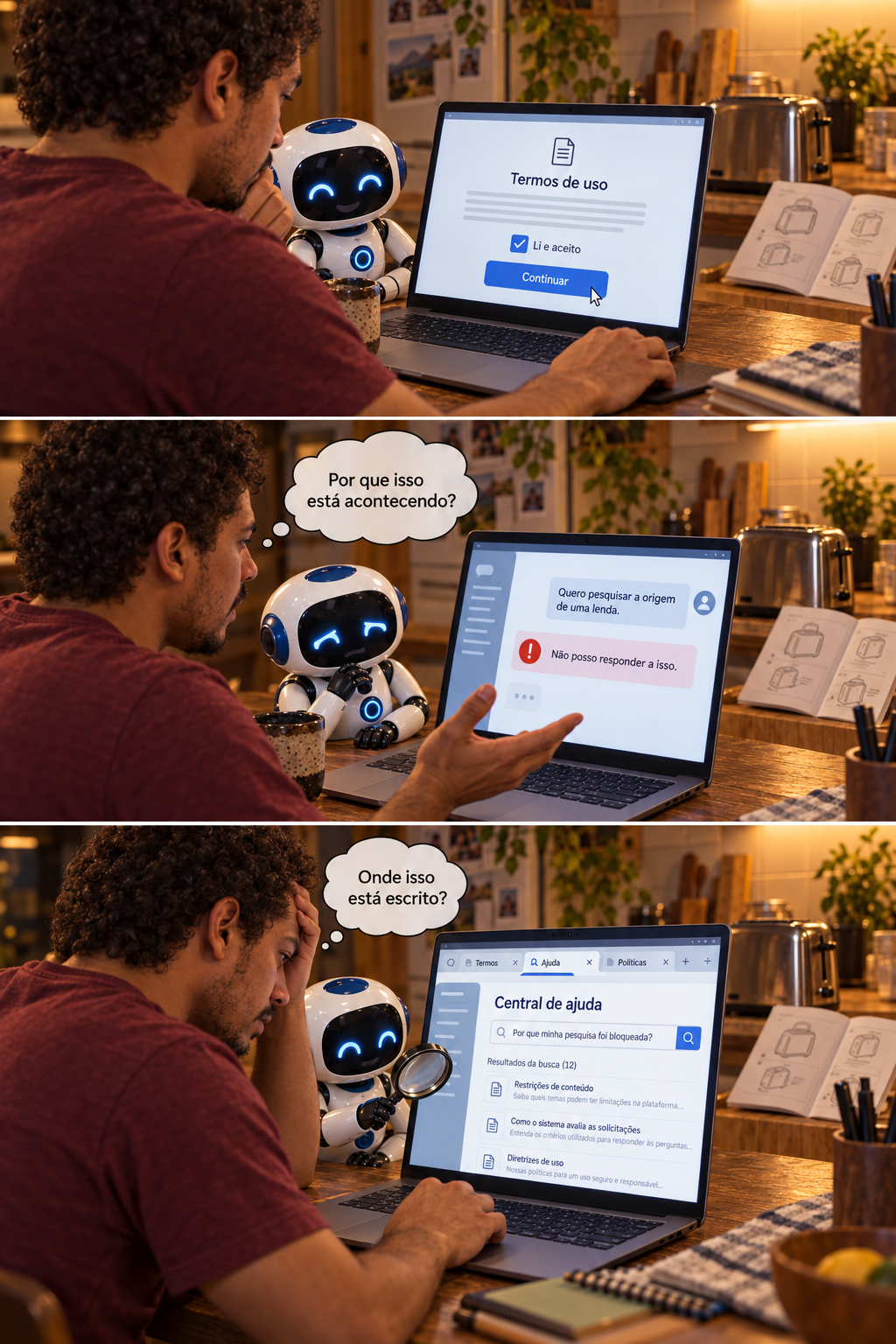
He sat down at the kitchen table, opened the sign-up page, and went through the terms of use. There were obligations, rules, and words that seemed quite clear as long as no concrete situation required understanding what they meant.
He checked “I have read and accept.” He clicked “Continue.”
On the counter, the toaster manual was still open. It even explained how to remove the crumbs.
The first question wasn’t in the sign-up
Later, he opened the chat to research the origin of a legend. He wanted to compare versions, find out where an association came from, and separate what had been told from what was documented.
“I can’t answer that.”
His hand stayed on the mouse.
Why was this happening?
He tried to explain the goal. He wasn’t asking the tool to present the legend as fact. He wanted to investigate the story people told.
The reply mentioned the service’s rules.
He remembered accepting those rules. He just didn't remember where they explained that case.
The research changed subjects
He opened the terms again. Then the help center. Then the policies.
The research on the legend gained three tabs about the tool that was supposed to help him research the legend.
He searched for “research.” He searched for “restrictions.” He searched for the reason for the refusal.
He found broad categories, general guidance, and links to other pages. He still needed to figure out which passage had been applied to the request — and why.
On the table, the cup was cooling. The robot followed the search, like someone trying to help find a passage in a document. The specific explanation was still missing.
He rested his forehead on his hand.
“Where is that written?”
He did not want to win an argument. He wanted to know how to use a tool for which he had gone through signup, accepted the terms, and set aside part of the evening.
The toaster booklet had a drawing of the crumb tray. He was beginning to feel an unexpected admiration for that tray.
How can software leave its manual up to the user?
That is the criticism the scene raises: a tool needs to explain how it works so that a person can use it, understand its limits, and act when something turns out differently than expected.
A conversation field does not replace those instructions. A list of example questions also does not, on its own, explain what the tool can do, what it cannot, and how to understand a refusal.
When that guidance is missing, the person ends up writing the manual while using it: they try a sentence, get a reply, change the request, and try to figure out which rule was in play.
The time for that investigation is taken from the task they came to do.
And what, exactly, was accepted?
The second criticism lies in the acceptance documents themselves. Terms may be available and still leave ambiguous what happens in concrete situations.
Broad wording and cross-references between pages can require an interpretation that the user only discovers after the incident. Clicking “I accept” records an action; it does not show that the limits became understandable.
In the story, the doubt remains: which rule applies to the research, how it was interpreted, and what path would allow it to continue?
The service should make that relationship legible. The person needs to be able to connect the condition they accepted to the decision they received, without relying on a long attempt to guess how the system works.
When he closed the tabs, he still had not finished the research. He knew how to remove the crumbs from the toaster.
What explanation was missing for you?
Have you ever accepted a tool’s terms and only later found a limit you didn’t know how to interpret? Tell us what you wanted to do, the explanation you looked for, and what allowed you to continue — or what went unanswered.
It’s also worth sharing when the documentation helped. Your story can show what kind of guidance Kuaapy’s services need to offer. The invitation is private; the experience does not automatically become a public comment or a testimonial with your name.