Having a model adapted to your project doesn't necessarily require building the entire model from scratch. An already pre-trained model can be the starting point.
There are several paths you can take from there. Two names worth knowing are Axolotl and MergeKit.
One base, different variants
A model family can bring together versions of different sizes and variants prepared to converse or carry out specific tasks. Sharing a family name does not make every version the same — nor does it guarantee that any combination will work.
The base model is the starting point. Adaptations change how it meets certain objectives.
Axolotl: adapting with examples
Axolotl organizes fine-tuning processes. You start from an existing model and adapt it using data chosen for the task.
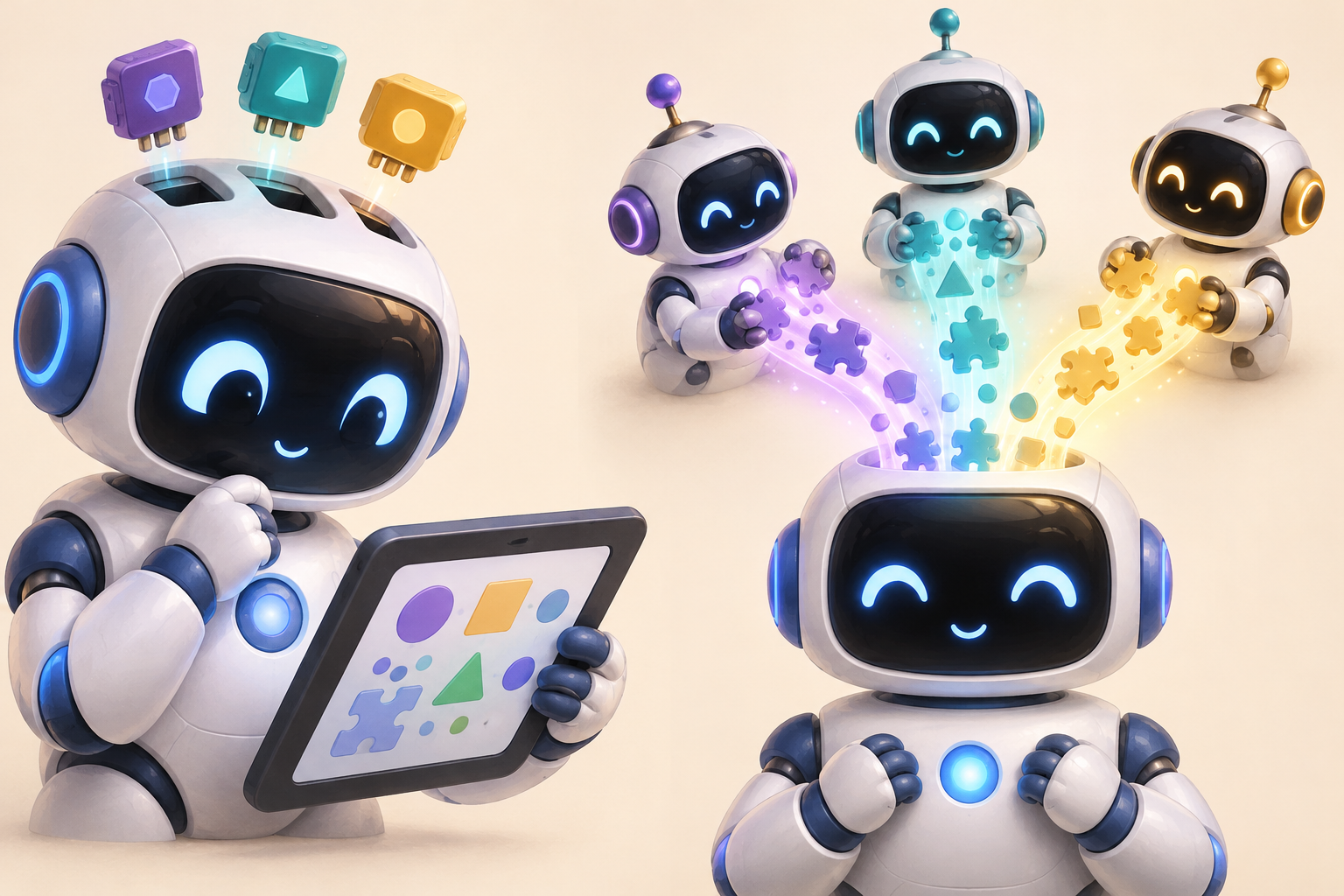
Among the available paths are LoRA and QLoRA, which train adapters: smaller sets of parameters added to the model. The small modules on the character’s head are a metaphor for these adapters, not a literal representation of the architecture.
This can be used to work on a response format, a specific task, or a domain. It is still training, but not training from scratch. The quality of the examples and the evaluation of the result make a difference. Get to know Axolotl.
MergeKit: combining existing models
MergeKit offers methods for combining model parameters. In many of these methods, combining them does not require a new training stage.
The idea is to experiment with what may emerge from combining compatible models. It is not simply adding intelligences together, nor does it guarantee a better result: capabilities can also be lost. Get to know MergeKit.
The right-hand side of the image represents that combination. It does not automatically describe a Mixture of Experts architecture, which is a different concept.
Choosing a path for what you want to do
Adapting with data and combining models are different possibilities. Knowing that difference already helps you research with a clearer question.
It is also worth separating these paths from customization by instructions: changing an application's prompt, by itself, neither trains adapters nor combines model weights.
This post is an entry point. The tools' sources explain methods, requirements, and examples. Before using a variant, check its origin, license, and how it was evaluated.
If you've already looked for an AI better suited to your project, tell us in the private story form: what would you like to adapt — and what difficulty did you run into getting there?