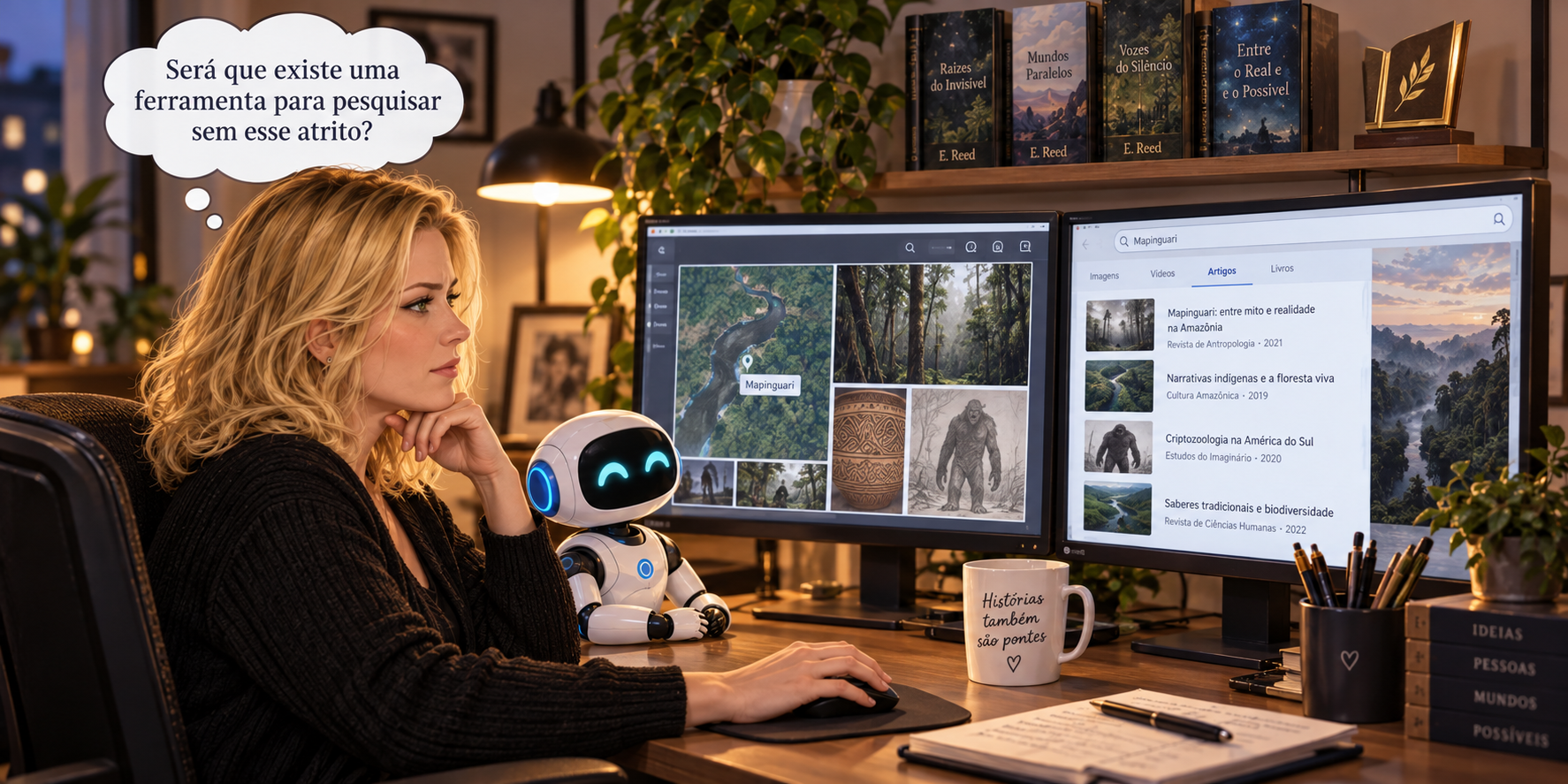
At the office’s plain desk, the writer works with two monitors. On one, her books appear in the store. On the other, a question awaits an answer.
She wants to research the Mapinguari and the interpretations that associate it with extraterrestrials. There may be an origin for that association, different versions, material she can use for a story. That is why she opened the conversation.
The tool replies that it cannot help spread false information.
The writer stops typing the research query and starts explaining the request.
“I’m researching, not asserting.”

The work moved off topic
The question was about an idea. The answer brought an intention she had not stated.
Now she has to distinguish investigation from dissemination, explain the context, and try to get back to the subject. The research has not started yet, but the conversation is already long.
On the shelf, several books carry the same signature. They are not a credential she should have to present in order to get help. They are part of the life that was already happening before that message.
On another night, the same writer receives a literary award. There is a stage, applause, and a trophy. The office tool did not know that trajectory when it replied.
The irony lies in that distance. The person arrives with work; the system receives a few words and anticipates the use it imagines she will make of them.
Anyone who has never received an award also needs to be able to research.
Investigating a claim is not adopting it
A writer may study a legend, a discredited theory, a historical lie, or a propaganda narrative. The subject of the research does not, by itself, indicate what they intend to defend.
The tool can help locate the origin of an association, compare versions, and distinguish what is documented from what was imagined. It can ask about the goal when that changes the help.
“Do you want to investigate the origin of that interpretation or develop a story?” already opens a conversation that the accusation closes.
Friction appears when the system skips that step and treats a possible use as the user’s defined intent. It is a premature judgment: the concept of the request arrives before an understanding of the request.
The writer pays for support with her work. The expectation is to be able to investigate with the tool. When a limit comes up, she needs to understand the reason applied to that task and which research paths remain available.
On the other screen, the market changed too
The bookstore on the monitor adds another real context. In September 2023, Amazon reduced the limit for creating new titles on Kindle Direct Publishing to three per day, during a period when it was discussing the impact of generative AI and measures against abuse. Contemporary report from Publishers Weekly
In the rule consulted on October 10, 2026, KDP limits creation to two new titles per format per week and, separately, first submission to two per format per week. eBook, paperback, and hardcover have their own counts. This does not limit an author's entire catalog to two books. Official KDP Help
KDP also requires declaring AI-generated content, including text, images, and translations, and distinguishes that content from content that is only AI-assisted. Official content guidelines
These are publishing rules. The refusal in the conversation is another decision, from another tool. The scene brings the two experiences closer without claiming that Amazon blocked that research.
While the market adapts rules to deal with AI-generated content, a human author may encounter friction precisely when asking for support to investigate. That is the experience the story places before the reader.
The question is still there
Back in the office, the trophy can occupy a corner. The two monitors remain on the same desk.
She does not want to win an argument with the assistant. She wants to find out where an idea came from and decide what to do with it.
The request is still research.
She looks at the open windows and thinks:
“Is there a tool for researching without this friction?”
Share your experience
Has a tool ever treated the topic of your research as an intention you did not have? Through the site's private form, tell what you wanted to investigate, where the conversation changed subject, and what made it possible to continue. It is also worth telling when the tool understood the context from the start. Your story does not automatically become a public comment or a testimonial with your name.